
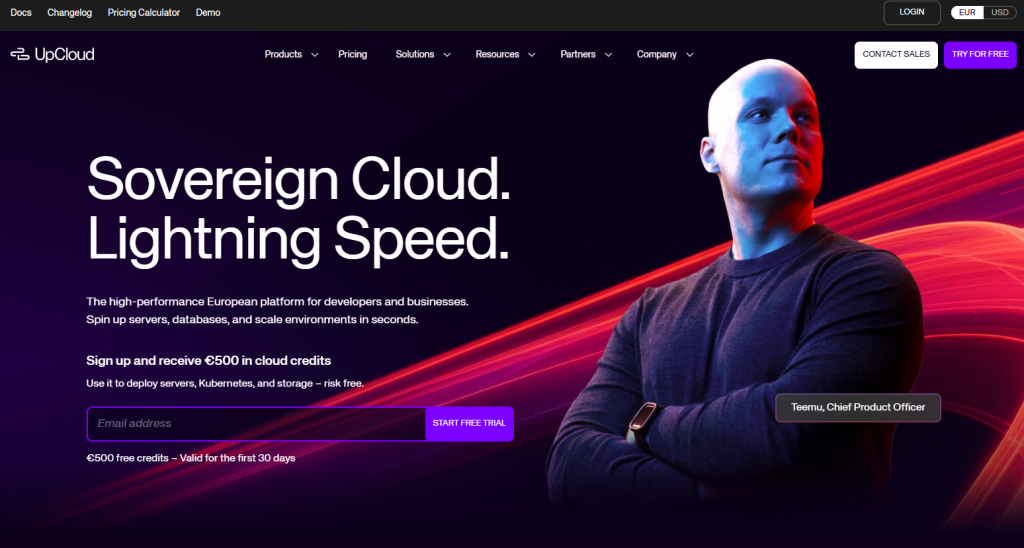
UpCloud is a global cloud infrastructure provider offering a European sovereign cloud platform designed for developers, small and medium-sized businesses, startups and digital agencies. Its services focus on high performance, predictable pricing and strong data protection, with infrastructure deployed across multiple data centers in Europe, North America and the Asia-Pacific region. The company emphasizes GDPR-compliant, ISO 27001 certified operations and a 99.999% uptime service level agreement for critical workloads, making it suitable for organizations that need reliable hosting and clear compliance posture.
Visitors to UpCloud can provision and manage a wide range of cloud resources. The core offering is cloud servers, which are virtual machines that can be deployed within seconds and billed on an hourly or monthly basis. Users can choose from predefined plans or configure custom instances with specific combinations of CPU cores, RAM and storage. There are specialized server categories such as developer cloud servers with low entry-level pricing, general-purpose and high-performance instances, and GPU servers designed for AI, machine learning and rendering workloads. These servers run on fast storage backends and connect to flexible networking features, forming the basis for hosting web applications, APIs, backend services and other compute-heavy workloads.
Beyond basic compute, UpCloud provides several managed and platform-level services. A managed Kubernetes service allows users to run containerized applications on a fully managed Kubernetes control plane. This service includes features typically associated with managed Kubernetes platforms, such as self-healing clusters, automatic scaling according to demand, service discovery between components and cluster autoscaling that adjusts node counts to optimize cost and performance. Users can integrate UpCloud’s file storage and networking with managed Kubernetes and follow official guides showing how to deploy and operate clusters in production.
UpCloud also offers managed databases, including PostgreSQL and Redis-based data stores. These managed database services handle provisioning, patching and maintenance while providing capabilities like automated failover, point-in-time recovery within specified recent time windows and scaling options designed to minimize downtime. Storage is allocated according to the chosen plan, and users can select CPU and memory configurations suited to their applications. These services help teams offload routine database administration while keeping data within UpCloud’s controlled infrastructure and compliance framework.
Storage options on UpCloud include different tiers of block storage for use with cloud servers, such as MaxIOPS for high performance and standard or archive tiers for less demanding or long-term data. There is also fully managed file storage, which provides a scalable shared file system that multiple servers or Kubernetes pods can access, useful for shared data and content repositories. Object storage may also be available through certain configurations, according to external comparisons and pricing breakdowns, enabling the storage of large datasets, backups or media assets in a more elastic format.
Networking features form another key part of the platform. UpCloud offers software-defined networking that lets users create private, isolated networks for their servers, enhancing security and organizing environments into logical segments. Additional networking tools include load balancers for distributing traffic across multiple servers to improve performance and high availability, and NAT gateways that allow resources in private networks to access the public internet without exposing them directly. These capabilities support more advanced architectures such as multi-tier applications, microservices and hybrid or multi-cloud setups.
The service is designed to be approachable both through a graphical control panel and programmatic interfaces. UpCloud’s web-based control panel provides a centralized interface for launching servers, configuring networks, managing storage and monitoring resource usage. For automation and integration into existing workflows, UpCloud offers a REST API, command-line tools (CLI) and support for infrastructure-as-code tools such as a Terraform provider. This allows developers and DevOps engineers to script deployments, manage infrastructure through configuration files and integrate UpCloud resources into CI/CD pipelines.
Documentation and learning resources are an important part of the visitor experience. UpCloud maintains a documentation portal with comprehensive guides on using its services, including topics like connecting to servers via SSH, configuring DNS, setting up load balancers, migrating between Kubernetes clusters and listing data center locations and IP ranges. In addition, the site hosts tutorials that walk through practical setups such as installing WordPress with Docker, deploying intrusion detection tools like Snort on Ubuntu, configuring VPNs with WireGuard, running Matrix Synapse, using GPU servers to run large language models locally, setting up pgvector with PostgreSQL, and getting started with specific cloud-native tools. These materials help prospective and existing users learn how to build and operate typical workloads on the platform.
UpCloud also curates broader content like case studies, blogs and events. Case studies highlight real-world customer scenarios, such as reductions in deployment time, cost savings, performance improvements and data sovereignty benefits achieved by businesses using UpCloud. The blog covers updates, feature announcements and technical topics relevant to cloud infrastructure and application development. Event listings inform visitors about upcoming webinars, community engagements or conferences where UpCloud participates. Together, these resources provide social proof and ongoing information about the ecosystem surrounding the platform.
The company offers several programs tailored to different audiences. A partner program targets digital agencies, managed service providers and resellers who build on or resell UpCloud’s infrastructure; it includes competitive pricing structures, support and incentives to help partners grow recurring revenue. A startup program provides free cloud credits and support to early-stage companies building and scaling minimum viable products (MVPs), making it easier to adopt the platform during the experimentation and growth phases. An affiliate program allows individuals or businesses to earn commissions for referring new customers, with reward structures that scale with the number and quality of conversions.
Typical use cases for UpCloud include hosting websites and e-commerce stores, running SaaS applications, deploying microservice architectures on Kubernetes, building AI and machine learning pipelines on GPU servers, maintaining development and staging environments, and providing infrastructure for agencies or managed service providers to support their clients. The platform is designed for roles such as developers and DevOps engineers who need quick server provisioning with full API access, CTOs and IT leaders seeking cost-effective, high-availability infrastructure for production workloads, digital agencies and MSPs that want to resell hosting, and startups looking for credits and support to launch new products.
Access to UpCloud generally begins with self-service registration, where visitors can sign up for an account to start a free trial or provision resources. The site advertises promotional credit offers, such as time-limited free credits that can be used to deploy servers, Kubernetes clusters and storage without financial risk during the trial period. Once registered, users can manage resources through the control panel or via API and CLI. Pricing is presented transparently on the site, with entry-level cloud server plans starting around €3 per month for small configurations and scaling upward with more CPU, memory and storage, and many services billed hourly to support flexible usage patterns.
Overall, UpCloud functions as a comprehensive cloud hosting and infrastructure platform with a strong focus on performance, European data sovereignty, predictable pricing and developer-centric tooling. Visitors can explore its product catalog, documentation, customer stories and program offerings to understand how to use the platform for web applications, data processing, AI workloads, containerized services and other cloud-native solutions.
Key features
- Global cloud infrastructure with multiple data centers located across Europe, North America and Asia Pacific, supporting low-latency hosting and regional deployment strategies.
- Cloud servers with fast provisioning, hourly billing and configurable CPU, RAM and storage options, including specialized developer, high-performance and GPU-based plans.
- Managed Kubernetes service providing a fully managed control plane, self-healing capabilities, automatic scaling, service discovery and cluster autoscaling for container-based applications.
- Managed database offerings such as PostgreSQL and Redis, with automated failover, point-in-time recovery and scaling features intended to reduce maintenance overhead.
- Multiple storage tiers including high-performance MaxIOPS block storage, standard and archive storage, plus fully managed file storage for shared data across instances or containers.
- Software-defined networking for creating private, isolated networks, along with load balancers and NAT gateways to support secure, scalable and highly available application architectures.
- Developer tooling including a web control panel, REST API, command-line interface and Terraform provider, enabling automation, infrastructure-as-code and integration with CI/CD workflows.
- Extensive documentation and tutorials covering server configuration, networking, Kubernetes, databases and popular application stacks, helping users learn and implement common cloud scenarios.
- Compliance and reliability features such as GDPR-compliant infrastructure, ISO 27001 certification and a 99.999% uptime SLA geared toward critical production workloads.
- Partner, startup and affiliate programs offering credits, discounts or commissions tailored to resellers, early-stage companies and referral partners.
Who it is for
- Software developers
- DevOps engineers
- CTOs and IT leaders
- Startups and founders
- Small and medium-sized businesses
- Digital agencies
- Managed service providers and resellers
- Organizations requiring European data sovereignty and GDPR-compliant hosting
Access and pricing
UpCloud uses a transparent, predictable pricing model with both monthly and hourly billing. Entry-level developer cloud server plans start at approximately €3 per month for small configurations with 1 CPU core, 1 GB of RAM and modest storage capacity. Higher-tier cloud servers scale in price according to added CPU cores, RAM and storage, with costs typically expressed per core and per gigabyte for custom plans. Managed PostgreSQL and Redis databases are offered on fixed plans that bundle CPU, memory and storage, with pricing that reflects the additional automated management, failover and recovery capabilities. Storage is billed per gigabyte per month, with different rates for MaxIOPS, standard and archive tiers, and file storage is priced according to capacity and performance options. Networking features such as load balancers and certain gateways are billed as separate services, while basic software-defined networking constructs are part of the platform. Many resources are billed hourly, allowing users to scale infrastructure up or down and pay only for actual usage. Promotional credits, startup program benefits and partner discounts can further affect effective costs for eligible users.