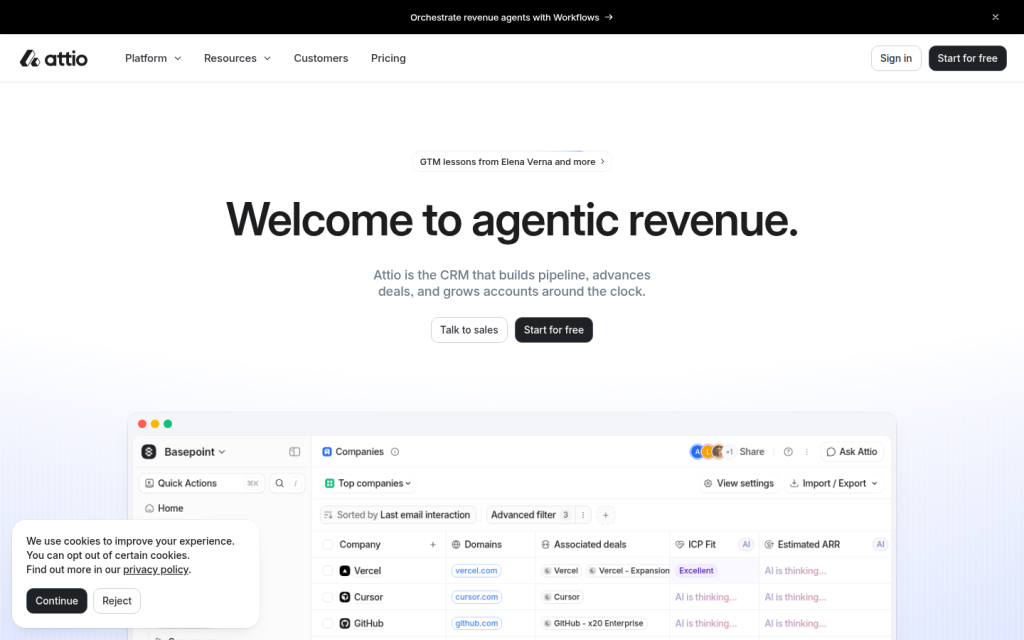
Attio is an AI-native customer relationship management (CRM) platform designed for modern revenue teams to build pipeline, accelerate deals and grow customer accounts. Its core purpose is to serve sales, customer success and go-to-market teams with a system that operates continuously, coordinating agents and workflows that prospect, qualify, and manage opportunities and accounts around the clock. Visitors to the site find a product focused on "agentic revenue," where software agents and automations handle much of the research, enrichment, routing and monitoring work, while human reps focus on conversations and closing deals.
The main subject and activity of Attio is revenue operations and customer relationship management. The platform combines a flexible CRM data model, AI capabilities and workflow automation to support the full lifecycle from initial lead capture through opportunity management, forecasting and ongoing account health tracking. Attio organizes data into objects and records, using what it calls universal context to automatically log communications and activity: emails, calls, calendar events, product usage signals, billing data and information from connected third-party tools are brought together into unified views of people, companies and deals. This gives users and AI agents a shared source of truth for sales and customer success work.
Visitors can explore several key product areas: pipeline management, AI agents and workflows, analytics and reporting, connectivity and extensibility, and customer stories and updates. In pipeline management, Attio provides deal boards, stages and timelines that show opportunities progressing through discovery, demo, proposal, negotiation and renewal, along with contextual information such as notes, stakeholders, recent activity and risk signals. The system can surface deals at risk, highlight stalled opportunities or changes in buying committees, and help reps prepare for calls by synthesizing data about quota coverage, deal velocity and potential obstacles.
Attio’s agents and workflows are an important part of what visitors can do. AI agents can prospect for new accounts, research companies and contacts, enrich incoming leads from web forms or other sources, score them for ideal customer profile fit, and route leads to the right representative based on segment, region or other criteria. Agents also assist with ongoing account management, tracking usage, billing issues and engagement patterns to flag renewal risk or upsell opportunities and draft suggested communications for the user to review and send. Workflows connect these agent actions into automated sequences triggered by events such as new records being created, changes in deal stages or upcoming renewal dates. Users can configure workflows to enrich data, score records, enroll leads into email sequences or notify team members, ensuring consistent execution of their go-to-market motions.
The platform places emphasis on freeing sales and success representatives from manual busywork. Agents handle research tasks, such as gathering information on hiring, funding, product changes or leadership moves at target accounts, and can summarize those findings into briefings ahead of meetings. Attio’s system can suggest personalized emails that tie recent events at an account, such as a new funding round or executive hire, to relevant offers or next steps. Users can then edit and send these messages from within Attio or connected email tools, keeping communication in sync with the CRM records.
Attio includes analytics and reporting capabilities tailored to revenue leaders and operators. Users can ask questions about weekly forecast, closed-won totals, performance by representative, pipeline coverage or account health, and the system can respond with metrics gathered from underlying datasets. The platform uses attributes, SQL queries and pre-built dashboards to help teams see book size, regional breakdowns, health segments like "healthy," "watch" or "at risk," and account-level signals related to usage, billing and engagement. This allows customer success managers and revenue leaders to identify which accounts need attention, plan renewal or expansion plays and monitor the impact of their GTM strategies.
Connectivity and ecosystem features are another major area visitors can explore. Attio is designed to work alongside other tools in a company’s stack, with integrations that keep data synchronized with communication platforms, productivity apps, product analytics and billing systems. The platform highlights integrations with tools such as Slack, Notion, Linear, AI models and other services, and supports access from different interfaces including web browser, email inbox, Slack and agent environments. For teams and developers, Attio offers an SDK, API and related developer resources that allow building custom agents, extending workflows, integrating internal systems or embedding Attio’s capabilities into other applications.
The typical use cases for Attio center on scaling sales and customer success operations. Startups and SaaS companies use Attio to replace spreadsheets and ad-hoc systems with a structured yet flexible CRM that can evolve with their business. Use cases include capturing and qualifying inbound leads, running outbound sequences to target accounts, managing opportunities through complex sales cycles, forecasting revenue, coordinating handoffs between sales and customer success, and proactively managing renewals and expansions. Attio’s AI agents also lend themselves to high-velocity lead triage, converting product signals from usage data into prioritization for sales follow-up, and continuously monitoring accounts for churn risk or upsell potential.
Attio’s intended audience is primarily go-to-market organizations: sales teams, revenue operations professionals, customer success managers, account executives, and startup founders building their first structured pipeline. The platform’s messaging and dedicated solution pages emphasize suitability for scaling startups, from early-stage companies hiring their first sales representatives up through teams preparing for later-stage growth. At the same time, features such as advanced permissions, enterprise connectivity, single sign-on and migration services indicate that Attio also targets larger organizations that need a production-grade CRM capable of handling high data volumes and complex access control.
Access and pricing follow a software-as-a-service model with multiple tiers. Public information describes Attio as offering a Free plan with a limited number of seats and records, intended for individuals or very small teams testing the product, and paid Plus and Pro plans on a per-user, per-month basis with both monthly and annual billing options. Pro and higher tiers generally unlock more records, objects and reports, along with advanced capabilities such as sequences, call intelligence, AI agents at higher usage limits and more granular permissions. An Enterprise tier with custom pricing is available for larger teams requiring features such as single sign-on and migration assistance. Attio also uses a credit-based system for AI features and workflow automations: each workspace and seat receives a certain number of credits included with the plan, and additional credit packages can be purchased when high usage requires more capacity.
Registration and onboarding typically involve creating a workspace, inviting team members and connecting core tools such as email and calendar. New workspaces often start on a time-limited trial of the Pro plan, giving teams the opportunity to explore advanced features before deciding whether to continue on Free or move to a paid tier. Users can sign up and start for free directly from the site, and there is also a sales-led path, with options to talk to Attio’s sales team for guidance on plan selection, implementation and migration from existing CRMs or spreadsheets.
Beyond the product itself, Attio’s site includes additional resources such as customer stories, changelog updates and educational content. Customer stories highlight how different companies use Attio to speed lead triage, turn product usage data into revenue signals, or scale their GTM processes. The changelog showcases frequent product updates and new features, reinforcing that the platform is actively developed and evolving. Visitors interested in learning more about go-to-market strategies and AI in revenue operations can also find lessons and commentary from practitioners and experts, positioning Attio not just as a tool but as part of a broader ecosystem around modern revenue management.
Overall, Attio presents itself as an intelligent, AI-powered CRM system built for teams that want a continuously operating revenue engine. It combines flexible data structures, automation, agents and connectivity to help organizations move beyond spreadsheet-based tracking or rigid legacy CRMs, enabling them to orchestrate pipeline, deals and accounts with greater speed and context while maintaining a shared system of record for all go-to-market activities.
Key features
- AI-native CRM platform focused on revenue operations and go-to-market teams.
- Universal context that unifies emails, calls, calendar events, product usage, billing data and connected tools into shared records.
- Flexible objects and records for modeling companies, people, deals and other business entities without a rigid schema.
- AI agents for prospecting, lead enrichment, scoring, routing, research and account monitoring.
- Configurable workflows that automate actions based on triggers such as new records, stage changes or upcoming renewals.
- Pipeline boards and deal stages with rich context, risk signals and activity timelines.
- Analytics and reporting for forecasts, pipeline coverage, performance by representative and account health.
- Tools for customer success and account management, including account health tracking, churn risk detection and upsell identification.
- Email capabilities with suggested, personalized outreach drafted by agents and support for sequences on higher tiers.
- Integrations with common SaaS tools used by revenue teams, including communication, productivity, product analytics and billing platforms.
- Access from browser, email inbox, Slack and other environments so users and agents can work where they already operate.
- Developer-facing SDK and API for building custom agents, workflows and integrations on top of Attio.
- Multi-tier SaaS pricing model with Free, Plus, Pro and Enterprise plans and a credit system for AI and workflow usage.
- Customer stories and changelog content illustrating real-world use and continuous product updates.
Who it is for
- Sales teams and revenue operations professionals in B2B organizations.
- Startup founders and early-stage companies building structured go-to-market processes.
- Scaling SaaS and technology companies needing a flexible, AI-powered CRM.
- Customer success managers and account managers responsible for renewals and expansions.
- GTM leaders and operators seeking analytics and automation for pipeline and account health management.
- Larger enterprises looking for an AI-native CRM with extensibility, advanced permissions and enterprise features.
Access and pricing
Attio is delivered as a subscription-based SaaS platform with a per-seat pricing model and multiple tiers. Public sources indicate four primary plans: Free, Plus, Pro and Enterprise. The Free plan is described as supporting a small number of seats and records, intended for individuals or very small teams evaluating the system. Plus and Pro are paid plans using per-user, per-month pricing with both monthly and annual billing options, with annual prices typically lower on a per-month basis than monthly billing. These tiers progressively increase limits on records, objects, emails and reports while unlocking features such as sequences, AI agents at higher usage, call intelligence and advanced permissions. Enterprise is offered at custom pricing for larger organizations, with additional capabilities such as single sign-on and migration assistance. Attio also uses a hybrid billing model that combines seat costs with a credit system: each plan includes monthly workspace and seat credits that power AI features and workflow automations, and additional credit packages can be purchased when usage exceeds included amounts. New workspaces generally begin with a time-limited free trial of the Pro plan before the team selects a long-term plan.