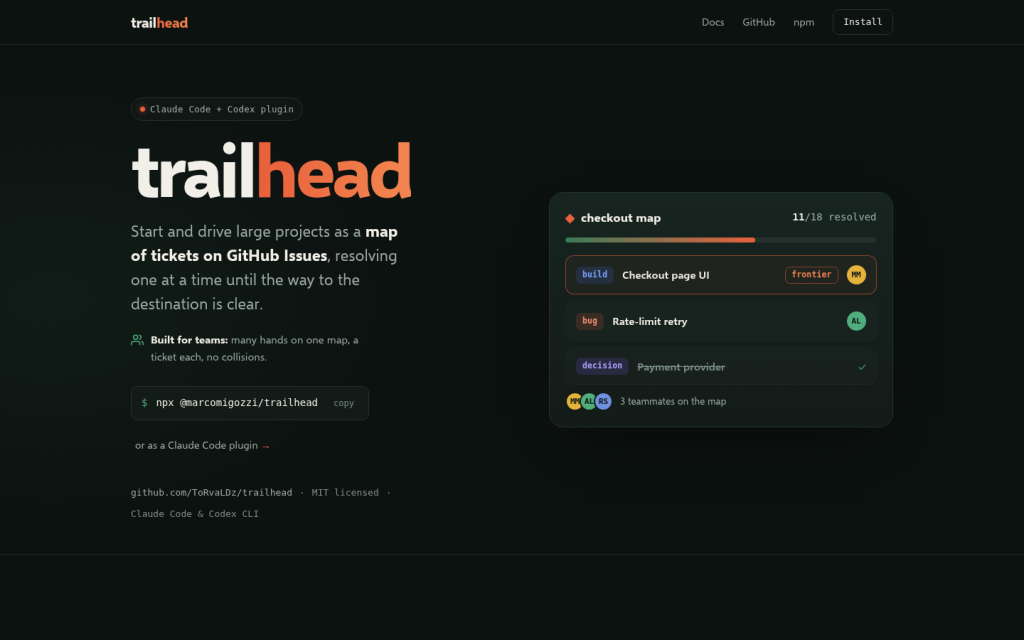
Trailhead is a project planning and execution tool that works as an agent and plugin for environments like Claude Code and Codex CLI, using GitHub Issues as the central place to map, plan and drive software projects. Its main purpose is to help teams start from a large, foggy idea and turn it into a disciplined sequence of tickets, each represented as GitHub issues, that lead step by step toward a working outcome.
At the core of Trailhead is the concept of a project "map". A map is modeled as a parent issue in a GitHub repository, while each ticket is a child issue with its own discussion, plan and execution history. The tool guides users through a workflow where ambiguous or fuzzy parts of a project sit in a "fog" and are gradually clarified through structured grilling conversations. Those grilling sessions ask focused questions one at a time until each decision becomes a closed choice, which is then captured as a real ticket on the frontier of the map. The frontier consists of open, unblocked tickets that can be taken now, while the destination is defined as a working artifact rather than just a specification.
Trailhead keeps everything on GitHub Issues so that plans, decisions, comments and commits are visible to the whole team in the repository rather than scattered across local planning directories or private notes. Discussion, plans and verification criteria live as comments on issues, and each build ticket is executed as a child of the map. The intended workflow is not just plan-and-hand-off; tickets move from discuss, to plan, to execute, to verify, with atomic commits that reference the ticket and appear in its timeline, providing traceability between code changes and project decisions.
The tool is designed for teams. It treats the tracker as the single source of truth, supports claiming tickets to lock them and prevent collisions, and allows multiple teammates to work on a shared frontier one ticket per session. Concurrency is handled by isolating concurrent work into separate tickets. Work can be paused, resumed or split as needed. Because the map and tickets live on GitHub Issues instead of local files, team members can pick up work on any machine with repository access, hand tickets to one another mid-flight and run multiple maps side by side, such as a checkout map and a billing map, without the two colliding.
Trailhead runs on agentic coding environments and is installed either as a Claude Code plugin or via a Node-based installer that projects host-native artifacts. It can also project a native skill and hooks for Codex CLI. Installation paths depend on the host, with commands provided to add the plugin from a marketplace, install it into Claude Code, or run npx commands to install into the agent’s configuration directory. For Codex, a specific flag projects a native Trailhead skill and hooks. Prerequisites include an authenticated GitHub CLI and a GitHub repository to work in, ensuring that the tool can manipulate issues and track work directly in the repository.
Trailhead builds in several engineering techniques as part of its workflow rather than adding them as optional extras. It includes grilling for decision-making, quick off-map capture for ad hoc tasks, design mockups, test-driven development at seams, adversarial code review, structured debugging and codebase mapping. Grilling converts vague decisions into closed choices through one-question-at-a-time interrogation. Off-map capture allows users to record bugs, to-dos or loose ideas onto a whiteboard without full map ceremony, then return to the main trail. For UI work, it suggests mocking up screens using external design tools before writing code, then reproducing those designs faithfully.
The heavy machinery features emphasize disciplined engineering practices. Test-driven development at seams is described as starting with a failing test at a real seam, making it pass and then refactoring, with an adjustable intensity per project. Adversarial code review examines each build’s diff across multiple axes, verifying findings before reporting them and avoiding reliance on assumed conventions. Debugging is framed as a scientific method: reproducing a problem, localising it, forming a falsifiable hypothesis, confirming the cause with a test and verifying the fix. Codebase mapping runs once per repository to fan out the architecture, stack, conventions and risks into a single issue the entire team can read.
Trailhead offers several read-only views and capture commands to help users know where they stand and quickly record work. Commands such as a map view render the destination, decisions made, the current frontier and remaining fog in a low-resolution view that shows where the project stands. A whiteboard view displays loose, map-less tickets and who holds each one, while a dashboard view pins an index issue that tracks all open maps, the whiteboard and live counts, providing a single click entry point within the repo. An inbox view triages issues that others have opened, allowing maintainers to fold worthwhile issues into a map in place while preserving authorship.
Zero-friction capture commands create different types of tickets quickly without derailing current work. A todo command generates small, defined build tickets for immediate work. A bug command records defects along with reproduction steps and can mark regressions of already shipped tickets. A seed command parks work until a future trigger, keeping it blocked and auditable so future work is not lost. A quick command lets users work one loose ticket start to finish off the map, grilling only if necessary and avoiding splits.
Because Trailhead ties the plan to GitHub Issues, the plan follows users wherever the repository is accessible. There is no need to sync local planning files or export project plans. The tracker serves as the single source of truth. Teams can run two important features as separate maps, each with its own frontier and grilling workflow, parking one and switching to the other as priorities change, then returning later without conflicts. This makes Trailhead suitable for managing longer-running features, refactors or cross-cutting initiatives that require clear, auditable progress.
Overall, Trailhead functions as a specialized planning and execution engine for software teams who use GitHub and agentic coding tools. It provides structured workflows, built-in agents and commands that transform fuzzy ideas into concrete tickets, keep all planning visible in the repository and support disciplined engineering practices from decision-making to testing, review and debugging. Visitors and users can learn about its concepts of maps, fog, frontier and destination, understand its commands and installation paths, and adopt it as a way to run their projects through GitHub Issues with integrated agent support.
Key features
- Uses GitHub Issues as the core project map, modeling the main project as a parent issue and each ticket as a child issue with comments, plans and execution history.
- Supports a workflow that moves tickets through discuss, plan, execute and verify phases, with atomic commits that reference tickets and appear in their timelines.
- Provides concepts of fog, frontier and destination to structure project progression, with fog representing unclarified work, frontier representing open, unblocked tickets, and destination as a working artifact.
- Runs as a plugin or skill for Claude Code and Codex CLI, installing into those environments and projecting agents, skills and hooks to manage project maps and tickets.
- Includes built-in grilling functionality that asks one pointed question at a time to turn fuzzy decisions into closed choices and create real tickets from them.
- Offers a whiteboard for off-map tickets such as bugs, to-dos and loose ideas, allowing quick capture and work off to the side without full map ceremony.
- Provides specialized views like a map view, whiteboard view, dashboard and inbox, each rendering different aspects of project status and ticket lists directly from the tracker.
- Implements zero-friction capture commands for different ticket types, such as todo, bug, seed and quick, enabling fast ticket creation without interrupting ongoing work.
- Builds in engineering practices such as test-driven development at seams, adversarial code review, scientific-method-based debugging and codebase mapping as Trailhead’s own agents.
- Supports running multiple maps side by side within the same repository, allowing teams to work on separate features or initiatives without collisions.
- Keeps the entire plan and ticket set on GitHub Issues, making the plan visible to all collaborators and portable across machines where the repository and authenticated GitHub CLI are available.
Who it is for
- Software development teams who use GitHub repositories and GitHub Issues to track work.
- Engineers and technical leads seeking structured, disciplined workflows for planning and executing complex projects.
- Users of agentic coding environments such as Claude Code and Codex CLI who want to extend their tools with project mapping and ticket management capabilities.
- Collaborative teams working on multi-feature, long-running projects that need visible plans, auditable progress and clear ticket-based workflows.
Access and pricing
Trailhead is described as MIT licensed and has a publicly accessible GitHub repository. There is no explicit mention of paid tiers, subscription plans or commercial pricing in the available information, suggesting that the core tool is open source under the MIT license, though formal pricing policies are not fully detailed.