
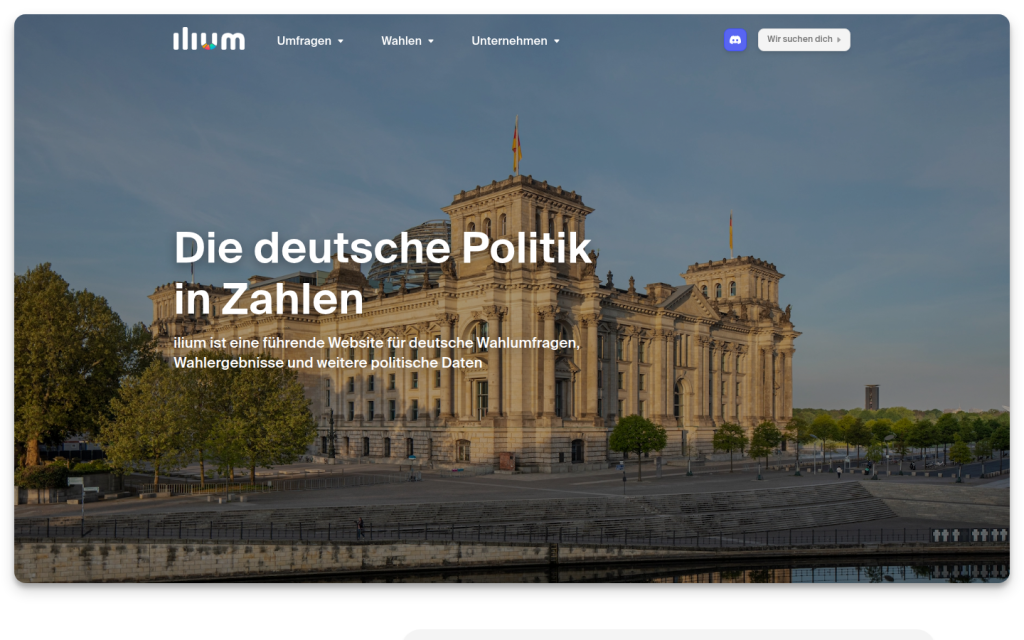
ilium.de is an online resource dedicated to German political polling and related electoral data. Its primary focus is on survey results and indicators that track the political mood in Germany over time. The site collects and presents information on election polls, party approval ratings, election outcomes and recurring survey questions such as the Sonntagsfrage, which asks voters which party they would support if a federal election were held in the near future.
Visitors can use ilium.de to explore current and past polling figures for major political parties in Germany. These figures typically include estimated vote shares and other indicators derived from surveys conducted by established German and international opinion research institutes. The site aims to provide a consolidated view of such survey data, allowing visitors to see how party support changes over time and how different polling organizations may report somewhat different results.
In addition to raw polling numbers, ilium.de includes analytical content that helps visitors understand the reliability and performance of various polling institutes. One publicly visible section is an institute ranking that focuses on the accuracy of German polling organizations, comparing how closely their surveys have matched actual election results over time. This type of content is designed to give users context about methodological differences and the track record of each provider, supporting a more informed reading of the published survey figures.
The overall subject matter of the site is German electoral politics and public opinion measurement. Users interested in the Bundestag elections, state-level elections or national trends in party popularity can find aggregated data and contextual information. Typical uses include tracking current polling levels for major and minor parties, reviewing how opinion has shifted over recent weeks or months, and examining how different institutes contribute to the broader picture of political sentiment.
ilium.de’s content appears to be primarily data-driven, focusing on tables, charts or structured numerical information rather than narrative commentary alone. It serves as a reference point for journalists, politically interested citizens, researchers, students and others who follow German politics and want to consult up-to-date survey figures and related metrics. The visitor experience is centered on viewing and comparing polling data and understanding its methodological background, rather than on participating in discussions or community features.
Access to the public pages of ilium.de is provided via a standard web browser without any evident mandatory registration for basic viewing of polling data and institute comparisons. The site presents itself as a general information resource rather than a closed subscription platform. Any additional services beyond publicly visible content were not clearly documented in the available information, so the core description focuses on its role as an accessible data and information site for German election polls and political statistics.
Key features
- Centralized presentation of German election poll results and related political data.
- Coverage of the Sonntagsfrage and similar recurring survey questions about voting intention in Germany.
- Display of party approval levels and trends across time, based on multiple polling institutes.
- Institute ranking content assessing and comparing the accuracy of German polling organizations.
- Contextual and explanatory information about political surveys, helping visitors interpret data and understand its limitations.
Who it is for
- People interested in German politics and election trends.
- Journalists and media professionals who need quick access to current polling figures.
- Researchers, analysts and students studying public opinion and electoral behavior in Germany.
- Politically engaged citizens who want to compare survey results from multiple polling institutes.